How Neurons Communicate - Sept. 27, 2000
Announcements:
READINGS THIS WEEK: Ch. 2 & 3 (up to p. 71)
Yalda's OH - Wed. 4:30-5:30 (CSB 102)
Notes:
Today's topic: synapses (how neurons talk to one another).
-a neuron by itself is "pretty stupid"
REVIEW:
Reminder of terms from last time:

- cell body (soma)
- axon - special "process" (arm coming out of the body - axon or dendrite) covered w/ myelin
- terminal button -- end of the axon
- dendrites - come out of the soma
There are more NA+ and Cl- ions outside of the cell than K-, and vice versa.
There are pumps on the membrane to keep sodium out of the cell. Sodium has a tendency to go into the cell (forced in by diffusion and electrostatic pressure). The other two ions have a balance of forces.
The action potential is the language the neurons have to talk to each other.
TODAY'S TOPIC:
Now we have this neuron that is "talking" (generating action potential)
-How is this translated for another neuron to understand?
-SYNAPSE
What does a synapse look like?
- terminal button attached to an axon. Inside the axon are microtubules for
support.
- along these microtubules are "balloons" filled with chemicals.
- these balloons are synaptic vesicles. They're filled with neurotransmitters.
- inside the terminal button are mitochondria (they produce ATP = energy for the cell)
- the vesicles concentrate themselves around the pre-synaptic membrane.
Some terms to get straight:
- PRE-SYNAPTIC
- SYNAPTIC CLEFT
- POST-SYNAPTIC
The synapse is a place! It's a gap filled with water and ions between the neurons! This gap is also called the synaptic cleft.
- On the pre-synaptic side of the cleft is the axon.
- On the post-synaptic side is the dendrite.
- there is a dark place on the two membranes - it's got special protein molecules (we'll get back to those)
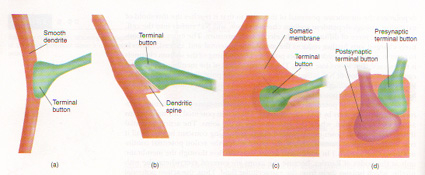 Where do you find synapses?
3 places:
- in between terminal buttons and dendrites (on spines or not).
- directly on the cell body (skips the dendrite altogether)
- in some weird cases, the synapse happens to be on another axon.
How do synapses work?/How are signals produced?
Steps in the basic mechanism:
- action potential generated near the soma. Travels very fast down the axon.
- -What happens when it reaches the terminal button?
- vesicles fuse with the pre-synaptic membrane. As they fuse, they
release their contents (neurotransmitters).
- Neurotransmitters flow into the synaptic cleft.
If the synaptic cleft looks the same on both sides, it's a symmetric
synapse. If the sides look different, it's an asymmetric
synapse.
- Now you have a neurotransmitter free in the synaptic cleft. On the
other side are receptors in the membrane. They're like keyholes. They let ions through if and only if neurotransmitters are bound to them! The neurotransmitter binds to the "keyhole" and lets ions through.
- -These receptors are called ionotrophic receptors. They allow
ions through.
So, the steps in generating action potential:
- - action potential generated.
- - vesicle fuses to pre-synaptic membrane.
- - release of neurotransmitters.
- - neurotransmitters bind to receptors.
- - ions flow through the open receptor.
There is another type of receptor - metabotrophic receptor.
This type binds the neurotransmitter like the ionotrophic receptor. But instead of letting ions go through directly, the metabotropic receptor activates the second messenger. This messenger goes to open the ion channels.
The metabotrophic mechanism is slower than the ionotrophic one, but it's very diffused.
-it will activate ion channels far away from the binding site.
The ionotrophic mechanism is very quick, but very local (only lets ions through right where the neurotransmitter is located).
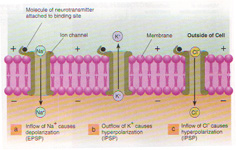 What is happening when ions are going through the membrane?
- ions carry charges.
- if there is a movement of charges, you get a change in voltage.
If the neurotransmitter binds to a sodium channel (NA+):
- sodium is allowed through the membrane and into the cell.
- What happens if you put positive charges inside the cell?
- if you depolarize the site, it's an EPSP - Excitatory Post-Synaptic Potential.
What happens is you have a different neurotransmitter that "opens the keyhole" of a potassium channel?
- K+ wants to leave the cell because of diffusion!
- Because K+ is positive, the inside of the cell becomes less positive (more negative) and there is hyperpolarization of the cell.
- Hyperpolarization creates an IPSP -- Inhibitory Post-Synaptic Potential.
Sodium depolarizes, potassium hyperpolarizes - What about chloride?
- You have more chloride outside the cell than inside. It wants to flow in by diffusion.
- Chloride is negative and makes the voltage inside the cell go down.
- Again, you get hyperpolarization, and this triggers an IPSP.
The final polarization the neurotransmitter creates depends on the type of channel it activates.
This process starts with electrical and ends with electrical signals. In between, there are chemical signals.
action potential > vesicle fusion > neurotransmitter release > receptor opening >
ion flow > EPSP/IPSP
Why not just "glue" together neurons?
Drugs work in the chemical stages (talk about that in Ch.4)
For the postsynaptic neuron to generate an action potential, it needs to receive a stimulus to bring it above the threshold of excitation. It needs a sum of stimuli. (two movies about this on the web)
After neurotransmitters bind to receptors in the synaptic cleft, what happens to them?
- they're destroyed in the synaptic cleft
- OR they're re-uptaken, (the excess is "sucked up" into the presynaptic site) to be repackaged in vesicles.
- The effect of cocaine is to block the re-uptake of the neurotransmitter (many effects, including hallucination)
What happens with EPSPs/IPSPs?
- neurointegration = the sum of the EPSPs and the IPSPs.
- EPSPs = positive voltage
- IPSPs = negative voltage
- When the neurons talk to each other, neurons are de- or hyper-polarized.
- Information from all the synapses integrated (summed) and the action potential will be generated if the threshold of excitation is reached. One neuron could have one or one hundred neurons (excitatory or inhibitory) all "talking" to it at different times, or at different rates.
There are 2 kinds of summation:
- spatial
- if a neuron has 4 synapses (2 excitatory, 2 inhibitory), and you have pulses from these at the same time:
- both excitations at the same time > neuron sees a big voltage
(depolarization)
- both inhibitors at the same time > neuron sees a small voltage
(hyperpolarization)
- one excitor and one inhibitor at the same time > neuron sees the
sum = zero!
- spatial summation - everything happens at the same time and different locations!
- temporal
- Things happen at basically the same place (1 synapse), but different times.
- if you have 2 action potentials, far apart in time, you'll see 2 "bumps" in the voltage.
- if you have 2 excitory impulses close to one another in time, there
will be summation. A bigger signal will be generated.
- if you have enough summation in time, you can generate action
potential (even with just one synapse receiving/firing action potentials - they fire one right after the other).
- if you have many inhibitory pulses, you won't get action
potential!!
- The summation "goes the wrong way" - negative!
In review, spatial summation involves many synapses at one time, and temporal summation involves one synapse at many times.
In real life, both types of summation are involved with the transmission of action potentials.
To summarize today's lecture:
The axon tries to reach the dendrite. Axons are filled with microtubules. On these are vesicles, which travel from the soma to the terminal button. The vesicles sit in the terminal button until an action potential is generated. In vesicles are neurotransmitters. a neuron can have only one kind of neurotransmitter. When action potential is reached, vesicles dock with the presynaptic membrane and fuse with it. They release neurotransmitters into the synaptic cleft. These neurotransmitters bind to receptors on the postsynaptic site. If the postsynaptic cell's receptors are ionotrophic, they allow ions to enter the postsynaptic cell directly. If they're metabotrophic, they activate second messengers to open ion channels. The postsynaptic neuron sums al the action potentials it receives and generates its own action potential on it's own axon, if the voltage of the summed pulses is greater than the threshold of excitation.
The symmetric and asymmetric synapses have different shapes and neurotransmitters.
- symmetric synapses usually deal with excitatory neurotransmitters.
- asymmetric synapses usually deal with inhibitory neurotransmitters.
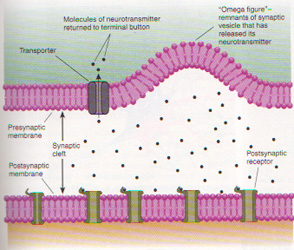
Neurotransmitter molecules are recycled back into the presynaptic site or destroyed by chemicals.
But sometimes, you have receptors in the presynaptic site. These are autoreceptors. The goal of autoreceptors is to modulate the production of neurotransmitters on the presynaptic side.
If there are too many vesicles, they'll be destroyed. If there are too few vesicles, the neuron won't talk.
- If someone has, for example, Parkinson's and has tremors, they can get a drug to destroy vesicles or neurotransmitters and stop the communication of the neuron(s) responsible and stop the tremors.
- Drugs can affect any of the steps discussed today.
All illustrations copied from
Foundations of Physiological Psychology,
by Neil R. Carlson.